
Defence
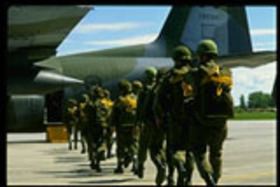
- (Photo: Notat)
The Lisbon Treaty has a special section on defence, Section 2 TEU. All decisions on defence have to be unanimous. A common defence can only be established by unanimity in the Council.
EU can take part in military actions - also without a mandate from the United Nations.
The Lisbon Treaty establishes a common defence policy in the EU and allows the use of enhanced cooperation and structured co-operation for more demanding missions.
Defence is part of the general foreign and security policy and military people are now part of the new common foreign and defence office established in the Charlemagne building in Brussels.
See the Lisbon Treaty from Art. 42 TEU. Structured cooperation for some of the member states is governed by Art. 46 TEU.
The Lisbon Treaty also includes a clause that commits the EU member states to be bound by a mutual defence obligation comparable to Article 5 of the NATO Treaty, which allows an element of choice for each state involved,and is not an automatic mutual defence obligation as in the similar Article 5 of the WEU Treaty.
This obligation, which is sometimes referred to as an "assistance clause", raises problems for neutral countries, as well as Denmark with its special defence opt-out.
Another so-called "solidarity clause" has been inserted into the Lisbon Traty committing the Union to assist a member state victim to a terrorist attack - see Art. 222 TFEU
The Treaty also legalise a common Weapons agency established in 2004.
HISTORY
Since the Treaty of Maastricht entered into force in 1993, the EU was allowed to establish a Common Security and Defence Policy (CSDP) as part of the Common Foreign and Security Policy (CFSP). It was finally decided to establish a CSDP at the Cologne Summit in 1999.
Decisions in the area of the CSDP require unanimity among the member states. The so-called Petersberg-Tasks, a list of security, defence and peacemaking tasks, were taken over from the Western European Union (WEU) and inserted into the TEU under the Treaty of Amsterdam. The WEU has thus lost its importance.
The EU Rapid Reaction Force
The Petersberg-Tasks were partly taken on by the EU's Rapid Reaction Force - some 60,000 personnel able to engage in combat for one year for purposes of "peacekeeping" and "peacemaking". For these forces, back-up troops of about 200,000 are needed.
The Rapid Reaction Force is not a standing EU army. The EU states have guaranteed to provide the necessary forces in certain circumstances. In this it is comparable to the mutual defence commitment of NATO members.
According to the EU Treaty, UN approval (a mandate) is not required for the operations of this force (see also Petersberg-Tasks).
Notes
- Sweden and Ireland have said that they will only participate in EU military actions that have a UN mandate.
- The first EU military operation has started in March 2003 in FYROM, (Former Yugoslav Republic of Macedonia) with a total budget of around 4.7 million Euro. This was funded from the normal EU budget.
- The first mission under the EU common foreign and security policy was a police mission in Bosnia, which started January 2003.
- The EU Defence is governed by an EU Military Committee, the EU Military Staff, and the Political and Security Committee.
- The EU establiushed a special intelligence unit called SitCen, renamed to IntCen in 2012 with 70 employed according to an answer in the European Parliament, see Europa- Parlamentet – Parliamentary questions
- There are 124 empoloyed in the European Defence Agency, see European Defence Agency – Annual Report 2013
- CAR – factsheet,
- There were 700 EUFOR soldiers 16 June 2014 in the Central African Republic, see EEAS – COMMUNIQUÉ DE PRESSE
- In Bosnia-Herzegovina there were 7000 soldiers, see EEAS – EUFOR ALTHEA factsheet and EUFOR - factsheet
- Finished missions, see EEAS – Completed missions and operations
More Links
European Battle groups, see:
http://consilium.europa.eu/media/1965617/factsheet_-_battlegroups_en-final-april_2013.pdf
EEAS – Ongoing missions and operations
Proposed amendments to the text of the articles of the treaty establishing a constitution for Europe: http://european-convention.eu.int/amendemTrait.asp?lang=EN
http://consilium.europa.eu/App......ID=80&LANG=1&cmsid=985
New plans for defence industry: http://euobserver.com/defence/124741
