
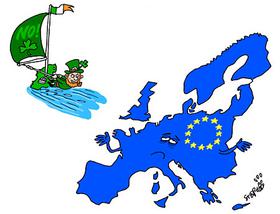
Irish declaration

- Declaration concerning Ireland to help the Irish government to have a new referendum for 2 October 2009 on the Lisbon Treaty (Photo: www.koreatimes.co.kr/.../2009/12/195_26016.html)
The European summit in Brussels in June 2009 adopted a declaration concerning Ireland to help the Irish government to have a new referendum for 2 October 2009 on the Lisbon Treaty. The Treaty was originally rejected by the Irish voters in a first referendum on 12 June 2008.
The declaration has the form of a "decision" in the European Council. It is modelled after a similar decision in the Edinburgh declaration from December 1992 after the Danish rejection of the Maastricht Treaty 2 June 1992.
The decision states explicitly that it does not change anything in the Lisbon Treaty. Therefore it does not need to be ratified by the member states. If it had added a new interpretation to just one single article, it would have had to be ratified again by all member states.
The decision is called "legally binding" under international law and it is archived in the United Nations register of international treaties. It cannot bind the European institutions since only the EU Court has the right to interpret the treaties according to Art. 344 TFEU.
The declaration may be inserted in a coming treaty on enlargement. It is a promise from the summit but will also require a unanimous decision among all member states when the next treaty on enlargement is drafted.
The declaration is called "Irish guarantees" by the government. Here we add different comments since the topic is very sensitive before the Irish referendum. In the bottom you will find a full booklet from the Irish governments foreign policy institute.
----
IRELAND - THE EMPEROR´S NEW CLOTHES
Comment by Jens-Peter Bonde, MEP 1979 – 2008. jp@bonde.dk
On Friday 19 June, a little before 3 pm, the Irish Prime Minister Brian Cowen entered his briefing room on the 20th floor in the Justus Lipsius bulding in Brussels to claim a big political victory.
- We came to have legally binding guarantees, and we got them.
The Irish had arranged a drama with the Council presidency and the British delegation by leaking a confidential letter from the Irish Prime Minister to the other Prime Ministers. He asked them to support a legally binding protocol on Irish concerns. To be able to call for and win a second referendum in Ireland.
The British played their role to perfection. It would be very difficult to deliver that to the Irish. The negotiations could not be finished on the first day. The prime ministers needed to use the night for these very difficult negotiations – resulting in a document that had actually been finalised days before...
The press was then invited to play their role in what looked like a re-play of the famous fairy tale of Hans Christian Andersen: The Emperors` New Clothes. Claim the big Irish victory to help the Irish prime minister convince the Irish voters to change their No into a Yes.
There is no real content in these so-called Irish guarantees. But they may be inserted in the next treaty following the implementation of the Lisbon Treaty. That may be the next accession treaty with Croatia.
It could also be a new protocol changing the numbers of seats in the European Parliament. Any treaty can include the document or part of the document called ”Ireland and the Treaty of Lisbon”.
That would make it legally binding. Until then it exists simply as a political agreement between prime ministers to agree on something at some point in the future. This is possible politically, but not legally.
No government can bind the next government. No parliament can bind voters to come back with support for this protocol. If Ireland insists that the agreement made on 19 June is legally binding there was only one way forward: to open the ratification process on the Lisbon Treaty again and have all 27 member states sign an amended Lisbon Treaty.
They cannot claim a legally binding victory and then avoid the ratification together with the Lisbon Treaty. Under EU law a protocol is only legally binding when ratified by all member states. There is no third way.
In 1992 the Danish government tried to bind a future Danish parliament by ratifying a change to come into effect at a later date. A professor of state law, the late High Court judge Henrik Zahle, issued a memorandum against ”giving up sovereignty in advance”.
The government had to withdraw this future decision from the referendum bill and give a free hand to future politicians. It is just as illegal attempt to bind future politicians to include the Irish Assurances in a future treaty.
It is not legally possible. Then, the Irish government will claim the commitment is legal under international law as a political agreement between the prime ministers. The agreement will be sent to the register of international agreements in the United Nations and thereby be legally binding between governments.
This is a breach of the Lisbon Treaty Art. 344 TFEU and the similar rule in the Nice Treaty forbidding member states from settling conflicts of interpretation outside the EU institutions. There is only one court able to settle conflicts between member states, and that is the European Court of Justice in Luxembourg.
THE DANISH OPT-OUTS
The European Council engaged in a similar exercise after the Danish No to the Maastricht Treaty in 1992. But that time the Danish opt-outs were already in the treaty. The treaty articles were legally binding.
The Edinburgh Agreement was more of a moral commitment from the other prime ministers. Conflicts over such matters could not be settled in the international Court in the Hague. Only in the EU Court in Luxembourg.
The whole EU Summit strategy for dealing with the Irish No vote was similar to the way the prime ministers of the time established the Edinburgh Agreement of December 1992. Denmark then exchanged its No to Maastricht for political guarantees that the Danish opt-outs from some provisions of that Treaty only could only be changed by a new Danish referendum.
The European Council has now made another "decision” of the prime ministers and presidents of the EU member states. This so-called ”decision” did not previously exist as a formal legal instrument of EU summits. It was specially invented to get around the Danish No to Maastricht in 1992, by the head of the Council legal service, Jean-Claude Piris.
It is a creative way of giving people a feeling of legal certainty which does not and cannot exist, since only properly ratified EU treaties, with their Protocols, can offer binding legal guarantees in EU law. This ”decision” of the EU summit changes absolutely nothing in the treaties. If it did change anything, even the smallest change could only be validated through new ratifications by all 27 member states in their national parliaments or by referendums.
Just as with the 1992 Edinburgh Agreement these Irish ”assurances” include an explicit statement that ”these concerns (are) in conformity with that treaty”. This is the core sentence in the Summit document. In the so-called ”Irish assurances” not one single comma in the Lisbon Treaty has been changed.
Up until now no government has been able to give a single example of a national law which cannot be affected in some way or other by the Lisbon Treaty. This does not mean that the current generation of politicians have in mind the establishment of European laws in all areas. But in reality they could do this if they wished with a few derogations.
Decisions of the European Court could also affect virtually every single area of what is currently believed to be a purely national responsibility.
This ”decision” of the EU summit isn’t signed by the heads of states or government. In legal form it is simply an Annex to a Summit Declaration which, in contrast to a Treaty Protocol, is not binding in EU law.
The ”decision” is followed by a common ”solemn declaration” which may express the intentions of the politicians taking part. It does not prevent politicians at future summits affecting these ”assurances”.
Finally, Ireland has its own Irish Declaration. A unilateral Declaration of this kind has to be interpreted as a statement of position by one state which the others do not necessarily agree with. If they did agree to it would have been part of the joint declaration or the earlier ”decision”, in the name of all 27 states.
----
PRESIDENCY CONCLUSIONS OF THE BRUSSELS EUROPEAN COUNCIL 18/19 JUNE 2009
(revised version 10 July 2009, available for download here)
ANNEX 1
DECISION OF THE HEADS OF STATE OR GOVERNMENT OF THE 27 MEMBER STATES OF THE EU, MEETING WITHIN THE EUROPEAN COUNCIL, ON THE CONCERNS OF THE IRISH PEOPLE ON THE TREATY OF LISBON
The Heads of State or Government of the 27 Member States of the European Union, whose Governments are signatories of the Treaty of Lisbon,
Taking note of the outcome of the Irish referendum of 12 June 2008 on the Treaty of Lisbon and of the concerns of the Irish people identified by the Taoiseach,
Desiring to address those concerns in conformity with that Treaty,
Having regard to the Conclusions of the European Council of 11-12 December 2008,
Have agreed on the following Decision:
Section A
Right to life, family and education
Nothing in the Treaty of Lisbon attributing legal status to the Charter of Fundamental Rights of the European Union, or in the provisions of that Treaty in the area of Freedom, Security and Justice affects in any way the scope and applicability of the protection of the right to life in Article 40.3.1, 40.3.2 and 40.3.3, the protection of the family in Article 41 and the protection of the rights in respect of education in Articles 42 and 44.2.4 and 44.2.5 provided by the Constitution of Ireland.
COMMENT: True, a treaty does not change the Irish constitution. However, the above is a misleading statement since the European Court has already taken decisions affecting Irish abortion law. In the so-called SPUC v. Grogan case of 1991 the European Court of Justice decided that abortion is a normal ”service” under the treaties which can normally be provided everywhere. Then the Court ”on balance” established an argument on proportionality where they accepted the Irish constitutional limits for the time being.
The Court Advocate General wanted to entirely overrule Art 40.3.1 of the Irish Constitution, but the Court did not go along with that proposal then. The European Parliament has called for legal access to abortion in all member states in a resolution of 2002. The Council of Europe sought similar access to abortion in 2008. It is unrealistic to expect the Court to take such a decision as long as abortion is forbidden in a big country like Poland. But the example quoted shows the misleading character of the new ”assurances”. The power to decide will always reside with the Court , even on the most sensitive ethical questions like euthanasia and abortion, which many people believe should be decided at the national level.
Moreover, the Lisbon Treaty would make all citizens of the 27 member states into real citizens of the European Union for the first time by conferring on them an ”additional” citizenship . Their rights and duties as EU citizens would ultimately be decided by the Court of Justice. It would therefore fall to the Court of Justice to apply the rights set out in the Charter of Fundamental Rights for the 500 million or so citizens of the EU.
Section B
Taxation
Nothing in the Treaty of Lisbon makes any change of any kind, for any Member State, to the extent or operation of the competence of the European Union in relation to taxation.
COMMENT: True, EU competence on taxation is not changed. The EU already has certain competences as regards taxes. The limiting principle is that all harmonization must be unanimous. The Lisbon Treaty would allow the governments unanimously to change from unanimity to decision by qualified majority (Art 48 TEU). The Treaty also inserts a new Protocol on the internal market which would permit the EU to outlaw national tax measures if they can be regarded as disturbing the internal market.
The Lisbon Treaty adds in the avoidance of "distortion of competition" as an aim of the tax paragraph in Art. 113 TFEU, thus opening the way for more court cases outlawing distorting tax rules, such as low corporation taxes, different taxation rules for foreign-owned assets etc. The Lisbon Treaty defines the Internal Market as an area without distortions of competition under Protocol No. 27 (On the Internal Market and Competition). This should strengthen the hand of the court in applying the internal market rules, which are decided by qualified majority vote, to get rid of such distortions.
The Commission has proposed a harmonisation of the tax base for corporate taxation based on the article dealing with indirect taxes . This was in the Commission’s annual work programme for 2008, but has been postponed until after the second Irish referendum on the Lisbon Treaty.
The Lisbon Treaty also provides for totally new taxes to be imposed by the EU to add to its ”own resources” by unanimity. Where are the new ”assurances” here?
Section C
Security and defence
The Union's action on the international scene is guided by the principles of democracy, the rule of law, the universality and indivisibility of human rights and fundamental freedoms, respect for human dignity, the principles of equality and solidarity, and respect for the principles of the United Nations Charter and international law.
The Union's common security and defence policy is an integral part of the common foreign and security policy and provides the Union with an operational capacity to undertake missions outside the Union for peace-keeping, conflict prevention and strengthening international security in accordance with the principles of the United Nations Charter. It does not prejudice the security and defence policy of each Member State, including Ireland, or the obligations of any Member State.
The Treaty of Lisbon does not affect or prejudice Ireland's traditional policy of military neutrality. It will be for Member States - including Ireland, acting in a spirit of solidarity and without prejudice to its traditional policy of military neutrality - to determine the nature of aid or assistance to be provided to a Member State which is the object of a terrorist attack or the victim of armed aggression on its territory.
Any decision to move to a common defence will require a unanimous decision of the European Council. It would be a matter for the Member States, including Ireland, to decide, in accordance with the provisions of the Treaty of Lisbon and with their respective constitutional requirements, whether or not to adopt a common defence.
COMMENT: A common defence may be established by unanimity for all, or for those participating in ”structured cooperation” by a sub-group of member states. Ireland decides its own position. The content is true, but again misleading since Ireland already has opted in favour of participating in the common European Defence Agency and all other military structures and activities of the EU. Denmark has derogation from these in a treaty Protocol and does not take part in EU defence matters even though it is a NATO country. The Treaty provides for a ”mutual” defence obligation on all member states.
Nothing in this Section affects or prejudices the position or policy of any other Member State on security and defence. It is also a matter for each Member State to decide, in accordance with the provisions of the Treaty of Lisbon and any domestic legal requirements, whether to participate in permanent structured cooperation or the European Defence Agency.
The Treaty of Lisbon does not provide for the creation of a European army or for conscription to any military formation.
COMMENT: The first European battle groups have already been established. They have decided upon a joint military force of 60,000 troops. No new treaty is required to increase this number to 600,000 or 6,000,000 EU soldiers. Where is the new assurance?
It does not affect the right of Ireland or any other Member State to determine the nature and volume of its defence and security expenditure and the nature of its defence capabilities. It will be a matter for Ireland or any other Member State, to decide, in accordance with any domestic legal requirements, whether or not to participate in any military operation.
Section D
Final provisions
This decision shall take effect on the same date as the Treaty of Lisbon.
ANNEX 2
SOLEMN DECLARATION ON WORKERS' RIGHTS, SOCIAL POLICY AND OTHER ISSUES
The European Council confirms the high importance which the Union attaches to:
• social progress and the protection of workers' rights;
COMMENT: Yet the 2007 Laval case has already permitted foreign workers to be employed for much lower salaries than the normal rates in Ireland. The Trade Unions in the European TUC proposed that a social protocol be added to the Lisbon Treaty to set this judgement aside. This protocol was fairly weak in its provisions, but even this was not accepted.
• Public services;
• The responsibility of Member States for the delivery of education and health services;
COMMENT: Yes, they may still be responsible. But the Court has already made rulings on requiring free competition for important areas of education and health. A patients’ directive currently being prepared will bring more detailed EU rules. Where are the new assurances?
• the essential role and wide discretion of national, regional and local authorities in providing, commissioning and organising services of general economic interest.
In doing so, it underlines the importance of respecting the overall framework and provisions of the EU Treaties.
To underline this, it recalls that the Treaties as modified by the Treaty of Lisbon:
• establish an internal market and aim at working for the sustainable development of Europe based on balanced economic growth and price stability, a highly competitive social market economy, aiming at full employment and social progress, and a high level of protection and improvement of the quality of the environment;
• give expression to the Union's values;
• recognise the rights, freedoms and principles set out in the Charter of Fundamental Rights of the European Union in accordance with Article 6 of the Treaty on European Union;
• aim to combat social exclusion and discrimination, and to promote social justice and protection, equality between women and men, solidarity between generations and protection of the rights of the child;
• oblige the Union, when defining and implementing its policies and activities, to take into account requirements linked to the promotion of a high level of employment, the guarantee of adequate social protection, the fight against social exclusion, and a high level of education, training and protection of human health;
• include, as a shared value of the Union, the essential role and the wide discretion of national, regional and local authorities in providing, commissioning and organizing services of general economic interest as closely as possible to the needs of the users;
• do not affect in any way the competence of Member States to provide, commission and organise non-economic services of general interest;
COMMENT: This is the case as long as all treaty principles relating to free competition, non-discrimination, etc. are respected. In reality there is not a single non-economic service which cannot be affected by judgements of the Court.
• provide that the Council, when acting in the area of common commercial policy, must act unanimously when negotiating and concluding international agreements in the field of trade in social, education and health services, where those agreements risk seriously disturbing the national organisation of such services and prejudicing the responsibility of Member States to deliver them; and
COMMENT: But who decides what is seriously disturbing the national organisation of such services”? It is the EU Commission, not Ireland.
Again, no new assurance. The phrases above hide the fact that new trade agreements will be adopted by majority votes as a general rule. Even the weak derogations mentioned can easily be changed from unanimity to qualified majoriy by the governments.
• provide that the Union recognises and promotes the role of the social partners at the level of the European Union, and facilitates dialogue between them, taking account of the diversity of national systems and respecting the autonomy of social partners.
ANNEX 3
NATIONAL DECLARATION BY IRELAND
Ireland reaffirms its attachment to the aims and principles of the Charter of the United Nations, which confers primary responsibility for the maintenance of international peace and security upon the United Nations Security Council.
Ireland recalls its commitment to the common foreign and security policy of the European Union, as approved on several occasions by the Irish people through referendum.
Ireland confirms that its participation in the European Union's common foreign and security policy does not prejudice its traditional policy of military neutrality. The Treaty on European Union makes clear that the Union's security and defence policy shall not prejudice the specific character of the security and defence policy of certain Member States.
In line with its traditional policy of military neutrality, Ireland is not bound by any mutual defence commitment. The Treaty on European Union specifies that any decision by the Union to move to a common defence would have to be taken by unanimous decision of the Member States and adopted in accordance with their respective constitutional requirements. The Constitution of Ireland requires that a referendum be held on the adoption of any such decision applicable to Ireland and this requirement will not be affected should Ireland ratify the Treaty of Lisbon.
Ireland reiterates its commitment to the ideal of peace and friendly cooperation amongst nations and to the principle of the peaceful resolution of international disputes. It reaffirms its strong commitment to conflict prevention, resolution and peacekeeping, and recalls the record of achievement of its personnel, military and civilian, in this regard.
It reiterates that the participation of contingents of the Irish Defence Forces in overseas operations, including those carried out under the European common security and defence policy requires (a) the authorisation of the operation by the Security Council or the General Assembly of the United Nations, (b) the agreement of the Irish Government, and (c) the approval of Dáil Éireann, in accordance with Irish law.
COMMENT: The Lisbon Treaty allows the EU to participate in wars without the authorisation of the UN. Ireland decides for itself whether it will participate in such wars with Irish soldiers. This is true but again it gives no new assurance.
Ireland notes that nothing obliges it to participate in permanent structured cooperation as provided for in the Treaty on European Union. Any decision enabling Ireland to participate will require the approval of Dáil Éireann in accordance with Irish law.
Ireland notes also that nothing obliges it to participate in the European Defence Agency, or in specific projects or programmes initiated under its auspices. Any decision to participate in such projects or programmes will be subject to national decision-making and the approval of Dáil Éireann in accordance with Irish law. Ireland declares that it will participate only in those projects and programmes that contribute to enhancing the capabilities required for participation in UN-mandated missions for peace-keeping, conflict prevention and strengthening international security, in accordance with the principles of the United Nations Charter.
COMMENT: But Ireland is already a member of the European Defence Agency. Here there may be something new; how will Ireland both at the same time participate in, and remain apart from some of its activities?
The situation set out in this Declaration would be unaffected by the entry into force of the Treaty of Lisbon. In the event of Ireland's ratification of the Treaty of Lisbon, this Declaration will be associated with Ireland's instrument of ratification.
COMMENT: This is of no legal significance. It simply means new wrapping paper around the same Lisbon Treaty and the same legal obligations. Nothing in the Lisbon Treaty will change
----
GENERAL COMMENTS:
• The vast majority of European laws will still be decided by civil servants behind closed doors under the Commission and Council instead of being adopted by elected representatives of the peoples.
• The non-elected Commission will still retain its monopoly of proposing all European laws instead of these being decided by elected representatives in national parliaments or directly by the voters.
• EU Meetings and documents will generally remain private instead of being governed by a new rule requiring all meetings and documents to be open and transparent, unless special excceptions are approved by elected representatives.
• Ireland and the other member states will lose their right to propose and decide their own commissioner under Lisbon. Instead the Irish Commissioner and other national Commissioners will be decided by the new Commission President, in whose appointment the big states will have a decisive say.
• Ireland will halve its voting strength in the Council of Ministers under Lisbon while Germany will double its voting strength, and France, Britain and Italy will increase theirs by 50 percent each.
• When Ireland joined the European Community in 1973, Germany, France and the UK had 3.3 times more votes than Ireland. Now Germany will have 18 times more votes than Ireland and Britain, France and Italy 14 times.
• The Irish ”assurances” do not explain how having half as much influence in the EU than Ireland has today would help fight unemployment and resolve its economic crisis in the interest of Irish companies, farmers and workers.
For further sources and information on the above comments, see the euabc.eu under Abortion, Taxation, Lisbon Treaty etc.
----
LISBON - THE IRISH GUARANTEES EXPLAINED
Lisbon - The Irish Guarantees Explained
Contents
Executive Summary p. 1
Background p. 2
Legal Status of Irish Guarantees p. 3
Content of Decisions p. 5
Political Declarations p. 8
© 2009 Institute of European Affairs.
All rights reserved.
This Publication may be reproduced in full or in part if accompanied with the
following citation:
IIEA, Lisbon : The Guarantees Explained, Institute of International and
European Affairs,
Dublin, Ireland, June 2009.
As an independent forum, the Institute does not express opinions of its own.
The views expressed
in its publications are solely the responsibility of the author.
ISBN: 978-1-907079-03-0
EAN: 9781907079030
1
Executive summary
This is an explanation of the agreement reached between the Heads of State or
Government of the
27 EU Member States on 19 June 2009 in Brussels, informally called ‘the
Guarantees’. They
consist of both legally binding agreements and political commitments.
Following the Irish ‘No’ vote in the referendum of 12 June 2008 on the Lisbon
Treaty, the
Member States began talks to investigate whether it was possible to reach a
compromise that
would respect both the Irish vote and the choices of other Member States in
ratifying the Treaty.
The Guarantees respect the two key conditions identified by the Member States:
(1) the Lisbon
Treaty remains unaltered (as to amend it would require other Member States to
re-ratify the
Treaty, which could be politically difficult in certain countries); (2) that
concerns voiced by Irish
voters are directly addressed in the form of legally binding clarifications on
sensitive areas of
Irish sovereignty.
The Guarantees comprise three documents:
1. Decision of the Heads of State or Government of EU Member States acting in
their
capacity as sovereign states. The Decision is an international agreement,
because the
Member States have clearly stated their intention for the document to be
binding upon
them under international law, like a contract. For extra legal certainty, the
provisions of
this Decision will become a protocol to the EU treaties in the near future.
The Decision contains 3 sections on Irish issues:
• Section A is a clarification that specific articles in the Constitution of
Ireland on the
protection of the right to life, family and education will not be affected by
the
Charter of Fundamental Rights of the EU or the justice provisions in the Lisbon
Treaty;
• Section B is confirmation that the Lisbon Treaty does nothing to change the
powers
of the Member States regarding taxation;
• Section C is a clarification that Ireland’s traditional policy of military
neutrality
will remain unchanged and unaffected by the Lisbon Treaty, and a reiteration of
Irish sovereignty in relation to other areas of EU security and defence policy.
The Decision will become legally binding at the same time as the Lisbon Treaty
enters
into force.
2. Solemn Declaration by the European Council on workers’ rights, social policy
and
other related issues;
3. National Declaration by Ireland on Irish security and defence policy.
In addition to the text, an important agreement was reached among the Member
States that if the
Lisbon Treaty enters into force, the European Commission shall continue to
include one
national of each Member State.
2
1. Background
On 12 June 2008, 53.4% of the Irish voting electorate, on a turnout of 53.1%,
voted ‘No’ in the
referendum on whether to amend the Constitution of Ireland to allow for
ratification of the Lisbon
Treaty.
The Taoiseach, Brian Cowen, stated in response to the referendum result that
“[in] a democracy,
the will of the people as expressed at the ballot box is sovereign. The
Government accepts and
respects the verdict of the Irish people.”1 The Taoiseach also underlined that
“Ireland has
absolutely no wish to halt the progress of a Union, which has been the greatest
force for peace
and prosperity in the history of Europe”. His statement emphasised “the need to
pause to absorb
what has happened and why, and to consult widely at home and with our European
partners”.
On this basis, the Department of Foreign Affairs commissioned independent
research into the
behaviour and attitudes of the electorate in the referendum of 12 June 2008.
This research, carried
out by Millward Brown IMS, identified trends and common opinions in the Irish
electorate.2
The principal findings of this research was elaborated on and debated in a
specially created
committee of the Oireachtas – the Sub-Committee on Ireland’s Future in the
European Union – in
order to identify the next steps following the referendum. The Sub-Committee
presented its final
report in November 2008.3
The Taoiseach presented the Government’s conclusions to the other EU leaders at
their meeting
on 11-12 December 2008 during the French Presidency of the EU.4 Under the
chairmanship of
President Nicolas Sarkozy agreement was reached between all the Member States,
consisting of a
two-part approach: the need to respect and respond to the concerns of those who
voted ‘No’ in the
Irish referendum of 12 June 2008; and the need to reconcile these concerns with
the decisions of
other Member States in ratifying the Lisbon Treaty.
The European Council agreed that, provided the Lisbon Treaty entered into
force, a decision
would be taken in accordance with the necessary legal procedures to ensure that
the European
Commission continues to include one national of each Member State. It was
further agreed that
Ireland would be given legal guarantees clarifying aspects of the Lisbon
Treaty.
Effectively, these undertakings constituted heads of an agreement that would be
made legally
binding at a future date.5
On 19 June 2009, the 27 Member States agreed and signed off on the text of the
Guarantees.
3
2. Legal status of the Irish Guarantees
The Irish Guarantees include a document called a Decision of the Heads of State
or
Government of the 27 Member States of the EU, meeting within the European
Council, on
the concerns of the Irish people on the Treaty of Lisbon. 6
The Decision closely follows the form and precedent used in the 1992 Edinburgh
Agreement,
which was negotiated among the then 12 Member States of the EEC to allow
Denmark to hold a
second referendum on the Maastricht Treaty.
EU Heads of State or Government agreed that the Decision is “legally binding
and will take effect
on the date of entry into force of the Treaty of Lisbon”.7 If the second
referendum on the Lisbon
Treaty is passed, Ireland’s instrument of ratification which will also refer to
the Decision, will be
lodged in Rome with the Italian Government which acts as depositary for EU
treaties.8
In public international law, the crucial element in determining the legal
effect of the document is
the intention of the parties (i.e. the Heads of State or Government) to be
legally bound under
international law. This intention is evidenced in the express statement by the
Member States at
the 19 June 2009 European Council meeting that the “Decision gives legal
guarantee” and “is
legally binding”.
The Vienna Convention on the Law of Treaties (1969) gives Heads of State or
Government full
powers in international law to conclude international agreements, which may be
termed treaties,
protocols, decisions etc.9 Such agreements are binding on the Member States by
a variety of
means, including “signature, exchange of instruments constituting a treaty,
ratification,
acceptance, approval or accession, or by any other means if so agreed.”10 In
accordance with
Article 29.5 of the Constitution of Ireland, the Decision, together with the
Lisbon Treaty, will be
laid before Dáil Éireann after they enter into force.
In compliance with Article 102 of the Charter of the United Nations, the
Decision (like the
Lisbon Treaty) will be registered in the Treaty Section of the UN Secretariat
in New York after it
enters into force. Registration is the prerequisite for an international
agreement to be capable of
being invoked before organs of the United Nations. States may register an
instrument with the
Treaty Section only if it constitutes an international agreement; accordingly,
registration will be
further clear evidence of the Decision’s legally binding character in international
law. The
Edinburgh Agreement was also registered with the United Nations.
The Decision agreed on 19 June, like the Edinburgh Decision on the Maastricht
Treaty,
constitutes an interpretative agreement that falls within the scope of Article
31 of the Vienna
Convention on the Law of Treaties. This article states that all parties to a
treaty must interpret its
provisions in good faith in accordance with the ordinary meaning to be given to
its terms in their
context and must respect any agreement or instrument made in that context. The
Decision
constitutes such an agreement.
The Member States have undertaken to include the provisions of the Decision as
a protocol to be
attached to the two founding treaties of the EU at the time of the conclusion
of the next accession
treaty. This could take place as early as 2010, should Croatia be ready to join
the EU at this time.
Although the Protocol containing the provisions of the Decision will not be
part of any future
accession treaty, it will be subject to ratification in the Member States at
the same time as that
treaty.
4
The Decision, as a legally binding agreement in public international law, is in
no way superior or
inferior to the EU treaties, which are also international treaties subject to
the same rules of public
international law. Both are governed by the same rules in international law.
The effect of putting
the provisions of the Decision into a protocol is therefore an additional
security measure, but the
fact that the Decision has legally binding character in international law is
sufficient to bind the
governments of the Member States.
In accordance with Article 31 of the Vienna Convention on the Law of Treaties,
the Member
States and the EU institutions, which operate within the competence given to the
Union by the
Member States, will have an obligation to interpret the Lisbon Treaty in line
with the Guarantees
in accordance with the rules of public international law, such as good faith
and respect for
international treaties (referred to as pacta sunt servanda). The Decision is to
be used for the
purpose of clarifying the Lisbon Treaty and the European Court of Justice will
interpret the
Lisbon Treaty in light of their terms.
5
3. Content of the Decision
The three parts of the Guarantees with legal status are explained below. The
text of the
Guarantees is reproduced in the boxes followed by an explanation.
A. Guarantee on provisions of the Constitution of Ireland on the protection of
the
right to life, family and education
This guarantee clarifies concerns raised by Irish voters about social and
ethical issues, such as
abortion, divorce, the role of the family as the primary educator and the role
of religion in
education. It underlines that the Charter of Fundamental Rights does not alter
the fundamental
rights guaranteed in the Constitution of Ireland on these issues.
Furthermore, the Protocol to the EU treaties on Ireland’s abortion policy
(Protocol on Article
40.3.3o of the Constitution of Ireland), which has been in force since 1993, is
unaffected.
B. Guarantee on taxation
This guarantee is clear in stating that nothing in the Lisbon Treaty makes any
change to the EU's
competence with respect to taxation and in particular the right of Member
States to set their own
corporation tax rates.
Retention of unanimity in voting on taxation policy matters was a key Irish aim
during negotiations
on the Treaty. That aim was fully achieved, and unanimity in voting on tax
matters remains
unchanged.
RIGHT TO LIFE, FAMILY AND EDUCATION
Nothing in the Treaty of Lisbon attributing legal status to the Charter of
Fundamental Rights of the
European Union, or in the provisions of that Treaty in the area of Freedom,
Security and Justice
affects in any way the scope and applicability of the protection of the right
to life in Article 40.3.1,
40.3.2 and 40.3.3, the protection of the family in Article 41 and the
protection of the rights in respect
of education in Articles 42 and 44.2.4 and 44.2.5 provided by the Constitution
of Ireland.
TAXATION
Nothing in the Treaty of Lisbon makes any change of any kind, for any Member
State, to the extent or
operation of the competence of the European Union in relation to taxation.
6
C. Guarantee on security and defence
SECURITY AND DEFENCE
The Union’s action on the international scene is guided by the principles of
democracy, the rule of
law, the universality and indivisibility of human rights and fundamental
freedoms, respect for human
dignity, the principles of equality and solidarity, and respect for the
principles of the United Nations
Charter and international law.
The Union’s common security and defence policy is an integral part of the
common foreign and
security policy and provides the Union with an operational capacity to
undertake missions outside
the Union for peace-keeping, conflict prevention and strengthening
international security in
accordance with the principles of the United Nations Charter.
It does not prejudice the security and defence policy of each Member State,
including Ireland, or the
obligations of any Member State.
The Treaty of Lisbon does not affect or prejudice Ireland’s traditional policy
of military neutrality.
It will be for Member States – including Ireland, acting in a spirit of
solidarity and without prejudice
to its traditional policy of military neutrality – to determine the nature of
aid or assistance to be
provided to a Member State which is the object of a terrorist attack or the
victim of armed
aggression on its territory.
Any decision to move to a common defence will require a unanimous decision of
the European
Council. It would be a matter for the Member States, including Ireland, to
decide, in accordance
with the provisions of the Treaty of Lisbon and with their respective
constitutional requirements,
whether or not to adopt a common defence.
Nothing in this Section affects or prejudices the position or policy of any
other Member State in
security and defence.
It is also a matter for each Member State to decide, in accordance with the
provisions of the Treaty
of Lisbon and any domestic legal requirements, whether to participate in
permanent structure
cooperation or the European Defence Agency.
The Treaty of Lisbon does not provide for the creation of a European army or
for conscription to any
military formation.
It does not affect the right of Ireland or any other Member State to determine
the nature and volume
of its defence and security expenditure and the nature of its defence
capabilities.
It will be a matter for Ireland or any other Member State, to decide, in
accordance with any domestic
legal requirements, whether or not to participate in any military operation.
7
The guarantee on the security and defence policy reiterates text used in the
Lisbon Treaty on the
EU’s values and principles that guide its action on the international scene. It
also restates six
specific areas of national sovereignty in EU security and defence policy. These
areas include:
• deciding the type of aid or other form of assistance that a Member State will
provide to
another Member State in the event of a terrorist attack or an act of armed
aggression
against that country;
• creation of a common European defence;
• participation in permanent structured cooperation (a form of enhanced
cooperation
among a group of Member States whose military capabilities fulfil a higher
criteria, but
subject to the same rules on security and defence policy that apply to all
Member States);
• participation in the European Defence Agency;
• deciding the nature and level of spending on defence; and
• participation in EU security and defence operations overseas where the
mission requires
the involvement of national defence forces.
Neutrality and protection of Irish security and defence policy have been
recurring themes in every
Irish referendum on EU treaties. The post-Lisbon Treaty referendum research findings
point to
concerns held by voters about the possibility of an erosion of Irish neutrality
and conscription to a
European army. In this survey, 33% of respondents (48% of ‘No’ voters and 26%
of ‘Yes’ voters)
believed that the Lisbon Treaty contained provision for the introduction of
conscription. The
ninth paragraph of the Guarantee on Security and Defence unambiguously states
that the Lisbon
Treaty does not provide for the creation of a European army or for
conscription.
Furthermore, Article 29.4.9o of the Constitution of Ireland establishes a
constitutional prohibition
on Ireland joining a common European defence, in the event that one should be
created. A
referendum would be required to allow Ireland to participate in any proposed
future common
defence.
8
4. Political Declarations
In addition to the legal text, two declarations are part of the Irish
Guarantees on the Lisbon
Treaty.
Solemn Declaration on Workers’ Rights, Social Policy and Other Issues
SOLEMN DECLARATION ON WORKERS’ RIGHTS, SOCIAL POLICY AND OTHER
ISSUES
The European Council confirms the high importance which the Union attaches to:
• social progress and the protection of workers’ rights;
• public services;
• the responsibility of Member States for the delivery of education and health
services;
• the essential role and wide discretion of national, regional and local
authorities in providing,
commissioning and organising services of general economic interest.
In doing so, it underlines the importance of respecting the overall framework
and provisions of the
EU Treaties.
To underline this, it recalls that the Treaties as modified by the Treaty of
Lisbon:
• establish an internal market and aim at working for the sustainable
development of Europe
based on balanced economic growth and price stability, a highly competitive
social market
economy, aiming at full employment and social progress, and a high level of
protection and
improvement of the quality of the environment;
• give expression to the Union’s values;
• recognise the rights, freedoms and principles set out in the Charter of
Fundamental Rights of
the European Union in accordance with Article 6 of the Treaty on European
Union;
• aim to combat social exclusion and discrimination, and to promote social
justice and
protection, equality between women and men, solidarity between generations and
protection
of the rights of the child;
• oblige the Union, when defining and implementing its policies and activities,
to take into
account requirements linked to the promotion of a high level of employment, the
guarantee
of adequate social protection, the fight against social exclusion, and a high
level of
education, training and protection of human health;
• include, as a shared value of the Union, the essential role and the wide
discretion of national,
regional and local authorities in providing, commissioning and organising
services of
general economic interest as closely as possible to the needs of the users;
• do not affect in any way the competence of Member States to provide,
commission and
organise non-economic services of general interest;
• provide that the Council, when acting in the area of common commercial
policy, must act
unanimously when negotiating and concluding international agreements in the
field of trade
in social, education and health services, where those agreements risk seriously
disturbing the
national organisation of such services and prejudicing the responsibility of
Member States to
deliver them; and
• provide that the Union recognises and promotes the role of the social
partners at the level of
the European Union, and facilitates dialogue between them, taking account of
the diversity
of national systems and respecting the autonomy of social partners.
9
The ‘Solemn Declaration’ does not have legally binding value, but is a restatement
of EU policies
as set out in the Lisbon Treaty and the existing treaties.
While the post-referendum research indicated that voters considered the
protection of workers’
rights very important, it is an area where the EU has limited powers to
legislate. National
governments retain large areas of sovereignty over their labour markets and
public services.
Instead, it provides supporting action, including the list of rights and
guarantees provided for in
the EU treaties and restated in the Solemn Declaration.
The Solemn Declaration sets out the EU’s actions in the field of social policy.
These include the
policies developed since the 1970s relating to equality between women and men;
protecting the
rights of the child; combating social exclusion; ensuring a high level of
employment; and a
guarantee of adequate social protection. Other key values and principles of the
EU’s activities in
the field of social policy are found in the Solemn Declaration.
It states explicitly that the EU does not in any way affect the authority of
the Member States to
organise their own public services. It also states that each Member State has a
veto when it comes
to international trade agreements where social, education or health services
may be affected.
Member States retain primary responsible for providing health, education or
social services.
Finally, the Declaration reiterates the special role for social partners at EU
level.
10
National Declaration by Ireland:
NATIONAL DECLARATION BY IRELAND
Ireland reaffirms its attachment to the aims and principles of the Charter of
the United Nations,
which confers primary responsibility for the maintenance of international peace
and security upon
the United Nations Security Council.
Ireland recalls its commitment to the common foreign and security policy of the
European Union, as
approved on several occasions by the Irish people through referendum.
Ireland confirms that its participation in the European Union’s common foreign
and security policy
does not prejudice its traditional policy of military neutrality. The Treaty on
European Union makes
clear that the Union’s security and defence policy shall not prejudice the
specific character of the
security and defence policy of certain Member States.
In line with its traditional policy of military neutrality, Ireland is not
bound by any mutual defence
commitment. The Treaty on European Union specifies that any decision by the
Union to move to a
common defence would have to be taken by unanimous decision of the Member
States and adopted
in accordance with their respective constitutional requirements. The
Constitution of Ireland requires
that a referendum be held on the adoption of any such decision applicable to
Ireland and this
requirement will not be affected should Ireland ratify the Treaty of Lisbon.
Ireland reiterates it commitment to the ideal of peace and friendly cooperation
amongst nations and
to the principle of the peaceful resolution of international disputes. It
reaffirms its strong
commitment to conflict prevention, resolution and peacekeeping, and recalls the
record of
achievement of its personnel, military and civilian, in this regard.
It reiterates that the participation of contingents of the Irish Defence Forces
in overseas operations,
including those carried out under the European common security and defence
policy requires (a) the
authorisation of the operation by the Security Council or the General Assembly
of the United
Nations, (b) the agreement of the Irish Government, and (c) the approval of
Dáil Éireann, in
accordance with Irish law.
Ireland notes that nothing obliges it to participate in permanent structured
cooperation as provided
for in the Treaty on European Union. Any decision enabling Ireland to
participate will require the
approval of Dáil Éireann in accordance with Irish law.
Ireland notes also that nothing obliges it to participate in the European
Defence Agency, or in
specific projects or programmes initiated under its auspices. Any decision to
participate in such
projects or programmes will be subject to national decision-making and the
approval of Dáil Éireann
in accordance with Irish law. Ireland declares that it will participate only in
those projects or
programmes that contribute to enhancing the capabilities required for
participation in UN-mandated
missions for peace-keeping, conflict prevention and strengthening international
security, in
accordance with the principles of the United Nations Charter.
The situation set out in this Declaration would be unaffected by the entry into
force of the Treaty of
Lisbon. In the event of Ireland’s ratification of the Treaty of Lisbon, this
Declaration will be
associated with Ireland’s instrument of ratification.
11
The National Declaration reaffirms Ireland’s commitment to the primary
responsibility of the
United Nations for peacekeeping and international security to the United
Nations. It restates the
‘Triple Lock’: the three conditions that Ireland must meet before the Irish
Defence Forces may be
deployed in crisis management operations overseas.
The National Declaration recalls the constitutional prohibition on Ireland ever
joining a common
European defence should it be proposed. Irish voters endorsed this
constitutional prohibition in
the Nice Treaty in 2002. A further referendum will be required if Ireland ever
wished to
participate in a common European defence.
The Irish Government has announced that it will introduce legislation giving
the Dáil power to
scrutinise and authorise Irish any future participation in the European Defence
Agency and
permanent structured cooperation.
Agreement on the composition of the European Commission
This amendment to the Lisbon Treaty ensures that Ireland will retain a
Commissioner.
The Lisbon Treaty amends the provision in the Nice Treaty that requires the EU
to reduce the size
of the Comm

