
Accountability and division of powers
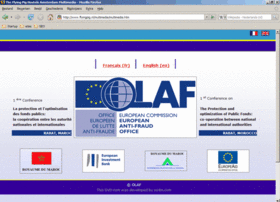
- The webpage of the European Anti-Fraud Office (Photo: www.xs4m.com)
Accountability and division of powers
To be accountable means to be answerable, responsible and subject to explaining and justifying one's actions or views. Within the EU political context a control framework is required where all actors involved can be checked and held responsible for any errors, political mistakes or abuse of money. Here are examples of such a control framework:
* Voters may control their elected representatives.
* MEPs may control the non-elected in the Commission.
* Commissioners may control their civil servants and working groups.
* Ministers may control their civil servants.
* The national MPs may control their ministers from their national parliament.
One talks about checks and balances. The French philosopher Montesquieu recommended the division of powers between legislative, executive and judicial powers as a basic condtion for any democracy. The aim was to hinder or limit the concentration of and possible misuse of power. The principle of the division of powers is not respected in the EU today.
In a democracy voters keep their representatives accountable for they are periodically elected.Members of parliaments have to justify themselves to their voters. They must explain what they are doing and show how they are voting. Otherwise they may not be re-elected.
MPs may also need to explain how they use their different secretarial allowances, as proved by the scandal over this matter in the UK in 2009. Many MPs, as published in the British press in May 2009, used taxpayer’s money for completely private purposes.
Without a control framework comes a sense of complacency, followed by an "abuse of position" or creation of an "elite class" and finally a loss of public confidence, once the poor practices are revealed.
In the European Union the European Parliament is the only body representing the voters directly. MEPs are accountable in the sense that they are voted in every 5 years. But in many countries that use party lilst systems of voting, candidates are simply put on a list by their party and the voters have no or a limited say on who is going to be elected.
In most countries it is very difficult to present a new list alongside the lists of the traditional parties represented in the national parliaments. Voters have a formal choice but not necessarily a real possibility to have their own views being represented by an MP or MEP.
Accountability could also mean that you should have the right to know how your MEP spends your money.
MEPs receive €4,299 per month in a general expenses allowance. MEPs do not need to deliver any proof as to how their money has been spent.
You should also be able to see how your MEP is voting on amendments and proposals for new laws. In the European Parliament this used be only possible when a political group called for so-called a roll-call vote.
Today you can consult a register on how individual MEPs have voted.
Commissioners need to be accountable to the European Parliament. They are obliged to answer questions from MEPs both orally and in writing. Many MEPs do not feel that they receive satisfactory answers. Many believe that the Commissioners are hiding too much; this is illstrated in the chapter on Transparency.
You should also have the right to know how the different Commissioners vote on the different topics put on their table, but at present one has no idea.
During 2004-14, under the mandate of Commission President Barroso, the Commissioners did not vote among themselves at all. Discussions took place behind closed doors on proposals for new EU laws.The Commission President often reads a text prepared by his official services. There is usually no real political debate. The President concludes. Most decisions are taken in the name of the Commission outside the Commission meeting room , as can be seen in the chapter on Democracy.
The Commission now publishes agendas and minutes of their decisions. However nowhere can it be seen how they actually came to those decisions. They do not provide access to documents relating to their discussions or preparations.
EU Commissioners give information about the amounts spent on representation. Yet this does not happen for individual spending, unlike what journalists can receive or request in most countries from their national ministers.
The Commissioners must now give details about gifts they receive, see Gifts.
Commissioners may hire special advisors. These names are now published - but the information does not include the salaries paid for the special advice they may receive from political friends or others.
Commissioners are proposed by the prime ministers or presidents of the member states. Often a prime minister or president proposes a candidate who could no longer be elected as an MP or appointed as a minister in his or her own country.
When former Prime Minister Tony Blair appointed Peter Mandelson as an EU Commissioner he had already been twice rejected as a minister by the British Parliament at Westminster.
Prime Ministers may sometimes propose the names of natilna politicians they want to get rid of. There is no election procedure safeguarding voters so that they may have the best candidate from their country.
One form of accountability could mean that the entire Commission would be elected by a majority in the European Parliament, with each national Commissioner being elected by the national parliament or directly by national voters in a direct election at the same time as the European elections every 5 years.
Ministers in the Council could be accountable for their speeches, negotiations and votes to the national parliament – and the voters whome they represent thete.
There is some EU accountability in some of the national parliaments. In Denmark the European Affairs committee has met in public every Friday since October 2006 and it can give negotiating mandates to Danish ministers before the latter can approve something in the EU Council of Ministers.
There is no other EU country where ministers need to have a negotiating mandate for such votes at EU level. In most countries the national MPs are rather badly informed about EU law proposals and have no real influence. Even in Denmark it is normally the civil servants in the ministries who decide and implement the Danish position in the 275 Council working groups.
They are assisted by 35 special committees composed of representatives from business organisations and NGOs in an tightly woven corporative system.
The ordinary members of parliament, the media and citizens are sidelined in the important preparatory phase where most EU decisions are prepared and then adopted.
The so-called negotiation mandate is often only given when the negotiations are in fact over and the formal decision is just waiting to be taken at a formal meeting of the Council of Ministers.
A simple reform as regards accountability would be to have all legislative decisions made by majorities in the national parliaments and/or the European Parliament. In the national parliaments the vote could only be a vote on the national input into the discussions. In the European Parliament it could cover also final approval of all EU laws by qualified majority in the Council of Ministers.
Germany is the only country that gives full access to all EU documents for its MPs.
See Democracy, Subsidiarity and Transparency.
